
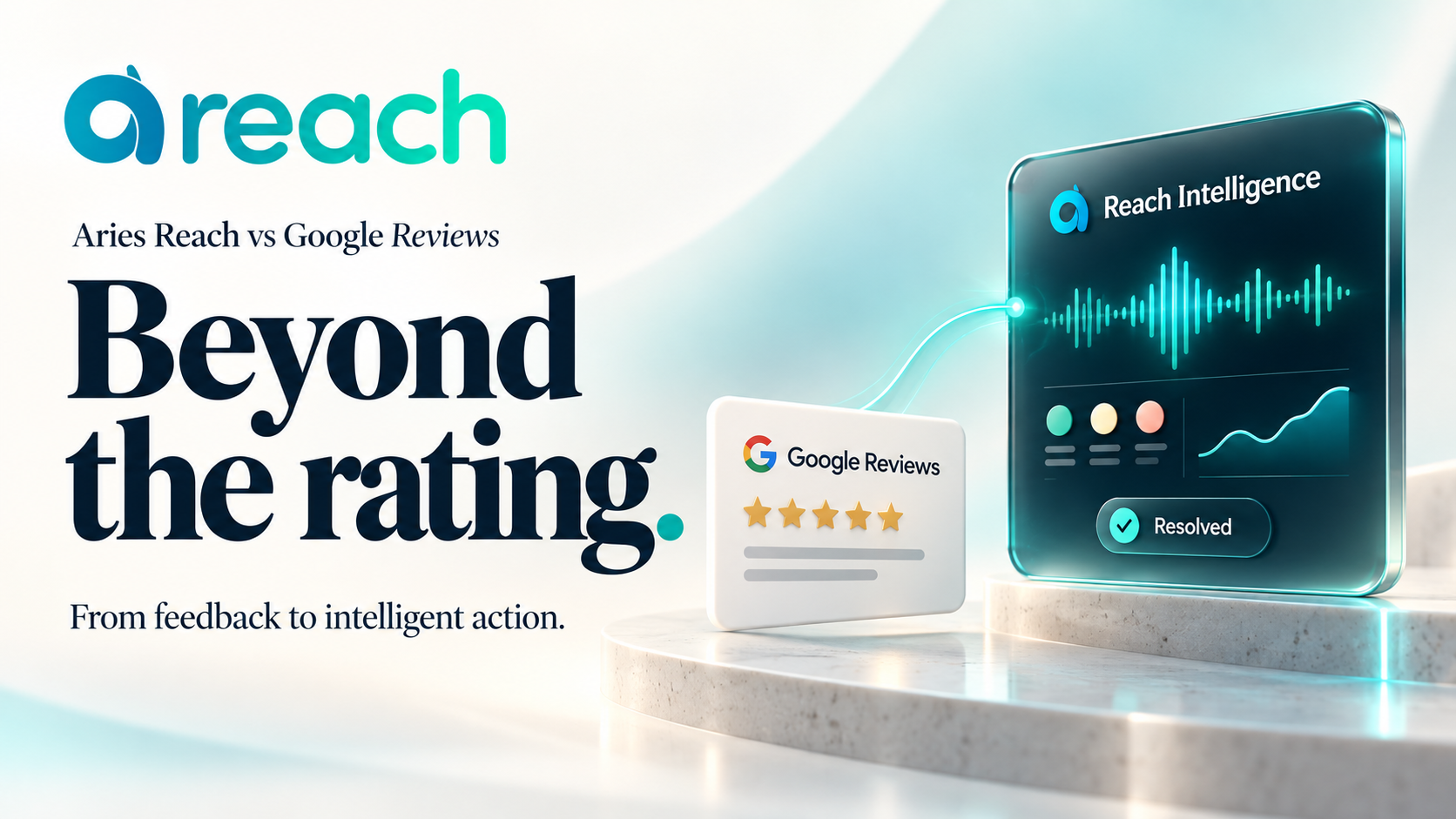
Your rating tells one part of the customer experience story
A customer gives your business three stars. Your team replies politely. But several operational questions remain: What caused the disappointment? Has the same issue appeared at other branches? Who will investigate it? How will management know whether it was resolved?
Public reviews influence how potential customers perceive a business. Improving the experience behind those reviews requires an ongoing process for collecting feedback, understanding its meaning, assigning responsibility, and measuring progress.
This is where Aries Reach provides its strongest advantage.
Google Reviews helps people discover and evaluate businesses through public feedback. Aries Reach gives organizations a dedicated environment for understanding customer experiences and managing the actions that follow.
For businesses seeking deeper insight and accountable follow-through, Reach adds capabilities that a public review page alone does not provide.
What Google Reviews does well
Google Reviews is an important part of a business’s public presence. Reviews appear alongside Business Profiles in Google Search and Maps, helping prospective customers evaluate their options. Businesses can request reviews through links or QR codes and respond publicly to customer feedback.
Google also provides Business Profile performance information, including profile views, website clicks, calls, and direction requests. Some profiles have access to additional insights based on public information, including reviews and local search trends.
These are useful capabilities. Reach’s advantage becomes clearer when the business needs to connect feedback with its internal operations, teams, and resolution process.
Aries Reach vs Google Reviews at a glance
Public discovery and reputation
Google Reviews helps potential customers evaluate your business through public ratings and reviews on Search and Maps. Aries Reach focuses on helping your organization understand customer experiences and act on feedback.
Feedback collection
Google supports public ratings and written reviews, collected through business listings, review links, and QR codes. Aries Reach adds dedicated voice feedback journeys and surveys, giving customers more ways to explain their experiences.
Experience context
Google reviews contain the information reviewers choose to share about a business. Aries Reach preserves source, language, location, and journey context to help teams investigate feedback. Where visit verification is configured, its reliability depends on the supporting evidence checked.
Analysis and insights
Google provides public ratings, review content, and available Business Profile insights. Aries Reach analyzes captured feedback with AI to identify sentiment and topics, helping teams understand recurring issues and areas for improvement.
Management reporting
Google Business Profile reports help businesses understand discovery and customer interactions, such as profile views, calls, and website clicks. Aries Reach provides feedback dashboards, reporting-period comparisons, and organizational-unit filters to support operational decisions.
Complaint handling
Google allows businesses to reply publicly and continue follow-up through other channels. Aries Reach supports complaint cases with assigned owners, priorities, deadlines, and service-level agreements, giving teams a structured process for tracking resolution.
Structured surveys
Google Reviews collects feedback through its public review experience. Aries Reach also supports configurable surveys in Arabic and English, helping organizations ask focused questions and understand the reasons behind customer ratings.
Deployment options
Google Reviews operates within Google’s services. Aries Reach offers cloud, private cloud, on-premises, and hybrid deployment options to accommodate different organizational requirements.
This comparison covers the native Google Reviews and Business Profile experience. External tools can add further analytics and workflows around Google reviews.
1. Feedback connected to the experience provides stronger context
A review becomes more useful when the organization understands where it came from and which experience it describes.
Aries Reach preserves source, language, location, and journey context alongside feedback. Its published platform also describes connecting relevant signals with transaction evidence when assessing customer claims. This gives teams a stronger foundation for investigating what happened.
Google requires reviews to reflect genuine experiences and moderates content for policy violations. Its published review submission process involves signing in, selecting a place, and submitting a rating or review; it does not describe a receipt or confirmed-visit requirement for every submission.
This makes the meaning of verification important. A location-specific QR code provides collection context. A verified visit requires evidence that establishes the visit, such as a matched service record or transaction.
For Reach implementations using visit verification, the verification label should reflect the evidence actually checked. The practical advantage is traceability: teams can investigate feedback using the context and supporting evidence available to them.
2. Voice feedback reveals details that ratings can miss
A star rating summarizes a reaction. A customer’s explanation reveals the details behind it.
Consider this feedback:
“The staff were helpful and the product was excellent, but I waited too long to complete the payment.”
One rating cannot fully express that combination of positive service, product satisfaction, and checkout frustration.
Reach’s voice feedback workflow allows customers to describe their experiences naturally. Transcription, translation, and AI analysis help teams review those explanations and identify the topics that need attention.
This is particularly useful for organizations serving customers in Arabic, English, and other languages. Teams can work with structured analysis while retaining the original feedback for review.
3. Operational dashboards help teams respond while issues are relevant
A business needs to understand more than its overall rating.
Managers may need to know:
- Which topics are appearing repeatedly?
- Which branches are receiving more negative feedback?
- Has satisfaction changed since an operational adjustment?
- Which complaints remain unresolved?
The Reach walkthrough demonstrates a central feedback inbox, sentiment labels, organizational dashboards, reporting-period comparisons, and scheduled reports.
These capabilities support ongoing visibility into feedback collected through the configured channels. As submissions are received and processed, teams can review emerging patterns and decide what needs attention.
The operational value of real-time insight is earlier awareness and faster decisions. Actual availability depends on capture, AI processing, and any connected systems.
4. Complaint management creates accountability beyond the reply
A thoughtful public reply matters. Resolving the underlying problem requires ownership and follow-through.
Reach allows teams to turn negative feedback into complaint cases, assign responsible owners, set priorities, and establish deadlines or service-level agreements.
That creates a clear sequence from feedback to action:
- Review the customer’s experience.
- Create a case with the relevant details.
- Assign responsibility and a target deadline.
- Follow progress through to resolution.
Managers can then review open cases and determine where further action is needed. This makes complaint handling part of a measurable management process.
5. Branch reporting supports targeted improvements
An organization-wide average can conceal differences between locations.
One branch may receive frequent praise for service while another experiences recurring delays. A single aggregate score provides limited guidance about where to intervene.
Reach’s reporting filters and period comparisons help managers examine feedback at the relevant organizational level. Its event analysis also supports comparing feedback during an event with an ordinary day at the same hours.
This helps teams investigate specific changes and choose improvements that address the experience in each location.
A practical example: repeated checkout delays
Imagine a retail business receiving several comments about slow checkout service.
On Google, customers may publish reviews and the business may respond. Those exchanges help communicate the business’s response to the public.
Using Reach’s demonstrated workflow, the team can collect detailed feedback, review the relevant topics, examine branch-level patterns, and assign complaints for follow-up. Management can then compare later reporting periods to assess whether the problem continues.
This is the central reason to add Reach: it connects customer feedback with the work required to improve the experience.
Why Aries Reach is the stronger choice for experience management
Reach is especially valuable when a business needs detailed feedback, multilingual understanding, visibility across branches, and clear responsibility for resolving complaints.
Its value is the connection between those activities. Customer feedback enters a shared workspace, becomes easier to interpret, and can lead to an assigned action whose progress is tracked.
Organizations with specific infrastructure requirements can also explore cloud, private cloud, on-premises, and hybrid deployment options.
Google Reviews remains valuable for public reputation. Reach strengthens the organization’s ability to manage the experiences that shape that reputation.
Use public reputation and experience intelligence together
Businesses can maintain their Google presence while using Reach to understand customers and improve service.
Feedback collection should welcome positive and negative experiences. Google prohibits incentives in exchange for reviews and selectively soliciting positive reviews, so internal feedback campaigns should remain separate from any rewarded or filtered Google review requests.
For leaders choosing where to invest, the deciding question is what the business needs to accomplish.
If the goal includes understanding recurring problems, supporting branch managers, and tracking complaints through resolution, Aries Reach provides a stronger operational foundation than relying on public reviews alone.
Explore Aries Reach and book a demo.
References
Enterprise intelligence becomes valuable when it can move from context to governed action.UNDERSTAND → DECIDE → ACT