
Beyond Agentic AI: Building Intelligence That Moves Business Forward
Artificial intelligence has entered a decisive new phase.
The conversation is no longer limited to what a model can generate, how naturally a chatbot can respond, or how impressive an AI demonstration appears. The more important question for business and government leaders is now much more practical:
Can artificial intelligence understand an organization’s context, support better decisions, and move real work forward?
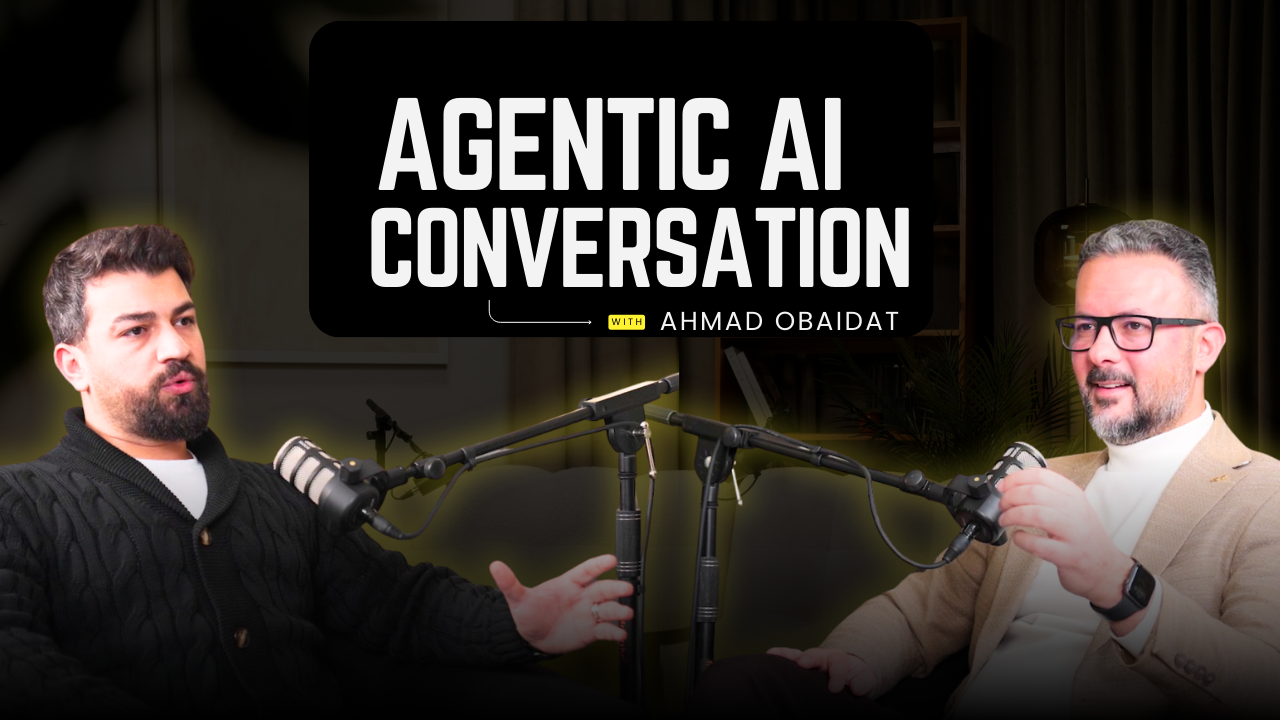
In the first episode of the Beyond Agentic AI podcast, Aries AI Co-Founder and Chief Executive Officer Ahmad Obaidat explores this transition—from general-purpose AI tools to specialized intelligent agents designed around actual organizational challenges.
The episode presents a clear vision for the future of enterprise AI: intelligence should not remain outside the organization as an isolated assistant. It should become a trusted part of how organizations understand customers, analyze performance, coordinate expertise, and act on evidence.
This is the direction Aries AI is building toward.
Moving Beyond the AI Demonstration
The first generation of generative AI adoption was largely experimental.
Organizations tested chatbots, content-generation tools, summarization systems, and isolated proofs of concept. These experiments demonstrated the extraordinary capabilities of modern AI, but many struggled to create lasting operational value.
A successful demonstration is not the same as a successful enterprise implementation.
For artificial intelligence to become genuinely useful, it must understand the environment in which it operates. It must connect with relevant organizational information, respect permissions and policies, produce traceable outcomes, and support the people responsible for making decisions.
This is the gap between AI that impresses and AI that improves the business.
During the podcast, Ahmad presents Aries AI as a company focused on closing that gap through practical, high-impact solutions. The objective is not to add AI wherever it appears fashionable. It is to apply specialized intelligence to problems where faster understanding, stronger decisions, and coordinated action can produce measurable value.
That philosophy remains central to Aries AI’s current direction: building secure, practical agents that help organizations understand faster, decide confidently, and act effectively. Aries AI’s company platform describes this as enterprise intelligence built around context, control, and outcomes.
What Does “Beyond Agentic AI” Mean?
Agentic AI is commonly described as artificial intelligence that can pursue objectives, use tools, make decisions, and complete sequences of tasks with less continuous instruction.
But autonomy alone is not the destination.
In an enterprise environment, unrestricted autonomy can create new risks. Organizations must know what information an agent used, why it reached a particular conclusion, what it is permitted to do, and when a human must remain in control.
Going beyond agentic AI therefore means combining agency with accountability.
An enterprise agent should be able to:
- Understand the business context behind a request.
- Access only the information it is authorized to use.
- Explain or support its conclusions with evidence.
- Work within defined organizational policies.
- Coordinate with people, systems, and other agents.
- Escalate sensitive decisions to the appropriate authority.
- Connect its work to a measurable business outcome.
This creates a more mature model of intelligence: not AI acting independently for its own sake, but AI collaborating with people to improve how the organization operates.
Aries AI’s Problem-First Philosophy
A central theme of the podcast is the importance of beginning with the business problem rather than the technology.
Organizations do not wake up needing a language model. They need to improve customer satisfaction, understand declining performance, reduce delays, identify risks, resolve service issues, or make better use of their data.
Technology becomes valuable when it is designed around those outcomes.
Aries AI follows a specialized-agent approach in which each agent addresses a defined enterprise mission. Instead of asking one generic assistant to understand every function, organizations can use focused intelligence built for a particular type of signal, decision, or workflow.
The podcast illustrates this direction through Aries Reach, Aries Insight, and Aries Council—three different expressions of how intelligent agents can create organizational value.
Aries Reach: Turning Customer Voice into Action
Organizations receive customer feedback through surveys, voice recordings, written comments, service channels, social platforms, and direct interactions. The difficulty is not simply capturing these responses; it is understanding what they reveal and acting before customer frustration becomes customer loss.
Aries Reach applies AI to voice and written feedback, transforming unstructured responses into clear customer-experience intelligence.
It helps organizations identify sentiment, satisfaction, recurring themes, service weaknesses, branch-level patterns, and issues that require attention. Leaders can obtain an enterprise-wide view, while local managers receive the information relevant to their own branches or responsibilities.
This changes feedback from a retrospective reporting exercise into an active operating capability.
A complaint can become a managed case. A recurring observation can reveal a systemic problem. Positive feedback can identify effective employees and successful practices. Patterns across branches can help leadership decide where training, investment, or intervention is required.
The deeper value of Aries Reach lies in connecting the customer’s voice with organizational responsibility.
Feedback is no longer collected merely to produce another satisfaction score. It becomes a signal that can inform a decision, activate an owner, and contribute to continuous improvement.
Aries Insight: Making Enterprise Data Accessible
Most organizations do not suffer from a lack of data. They suffer from a lack of timely, accessible understanding.
Business information is distributed across databases, operational systems, spreadsheets, dashboards, and departmental reports. Obtaining a clear answer may require technical teams to extract data, analysts to prepare reports, and managers to interpret results after the decision window has already narrowed.
Aries Insight is designed to reduce this distance between data and decision.
The platform enables decision-makers to interact with organizational data more naturally and convert complex information into understandable dashboards, analysis, and actionable insight.
This represents an important shift in business intelligence.
Traditional dashboards are generally designed around questions anticipated in advance. Decision-makers can explore available charts, but new questions often require a new report or additional technical work.
An intelligent analytics agent creates a more dynamic relationship. Leaders can explore what is happening, investigate why it is happening, compare performance, and move from one question to the next as their understanding develops.
The purpose is not to remove analysts or replace human judgment. It is to make organizational intelligence available closer to the moment of decision.
When authorized leaders can access reliable insight without navigating unnecessary technical complexity, the organization becomes more responsive. Teams spend less time searching for information and more time evaluating what the information means.
Aries Council: Intelligence Through Collaboration
The podcast also explores Aries Council, a collaborative AI concept in which multiple specialized agents examine a challenge from different business perspectives.
This addresses an important limitation of relying on one general-purpose answer.
Complex organizational decisions rarely belong to a single discipline. A new initiative may involve financial implications, operational constraints, customer impact, technology requirements, legal considerations, and strategic risk.
A finance perspective may identify a concern that a marketing perspective overlooks. An operations perspective may reveal a practical limitation that is not visible in the initial strategy. A risk-focused agent may challenge assumptions that other agents accept.
Aries Council brings these perspectives into a coordinated reasoning process.
Instead of receiving one immediate answer from one AI persona, the user can benefit from multiple specialized viewpoints that examine the problem, test assumptions, and contribute to a more complete outcome.
The important innovation is not simply placing several agents in the same interface. It is orchestrating them around a shared objective.
Effective multi-agent collaboration requires clarity about:
- The role assigned to each agent.
- The context available to the group.
- How disagreements should be evaluated.
- Which evidence supports each conclusion.
- How recommendations are consolidated.
- Where final human authority remains.
When these elements are governed effectively, multi-agent intelligence can help leaders consider a problem more deeply without losing control of the decision.
One Vision Across Different Products
Aries Reach, Aries Insight, and Aries Council address different organizational needs, but they share one underlying principle:
Intelligence becomes valuable when it connects context to action.
Aries Reach begins with customer voice. Aries Insight begins with organizational data. Aries Council begins with a complex question requiring multiple perspectives.
Each product transforms its starting signal into a clearer understanding that can support a decision or action.
This reflects a broader evolution in enterprise technology. Organizations have spent decades implementing systems that record transactions, store documents, capture incidents, and manage workflows. These systems remain essential, but they often leave people responsible for interpreting fragmented information manually.
Intelligent agents can become a layer between enterprise signals and enterprise action.
They can help organizations understand what their systems contain, identify what matters, recommend what should happen next, and activate approved processes while preserving human accountability.
Governance Is What Makes Enterprise Agency Possible
The more capable an AI agent becomes, the more important governance becomes.
An agent that only drafts a paragraph creates limited operational risk. An agent that analyzes private organizational data, recommends a strategic decision, or activates a workflow must operate within much stronger boundaries.
Enterprise AI therefore requires more than model accuracy. It requires identity controls, permission-aware access, data protection, evidence preservation, human approval, and traceable actions.
Governance should not be treated as an obstacle to innovation. It is what allows AI to move from experimentation into trusted operational use.
When people understand what an agent can access, what it can do, and where its authority ends, they can use its capabilities with greater confidence.
This is particularly important for governments, financial institutions, utilities, healthcare providers, and large enterprises, where decisions may affect sensitive data, essential services, public trust, or regulatory obligations.
The Human Role Becomes More Important
The rise of intelligent agents does not eliminate the role of people. It changes where human value is concentrated.
AI can process large volumes of information, detect patterns, summarize evidence, and automate repetitive steps. People remain responsible for purpose, judgment, ethics, relationships, and accountability.
The strongest model is therefore not human versus AI. It is structured collaboration between human expertise and machine intelligence.
In this model:
- AI expands the amount of information people can understand.
- AI reduces the time required to move from signal to insight.
- AI supports consistency across repetitive decisions.
- Humans define objectives and acceptable boundaries.
- Humans evaluate consequences and resolve ambiguity.
- Humans retain authority over sensitive or high-impact actions.
This partnership enables people to focus more of their time on the decisions that genuinely require experience, leadership, and responsibility.
A Practical Road Map for Business Leaders
The podcast offers an important lesson for organizations considering AI adoption: begin with value, not novelty.
A practical enterprise-AI program should answer five questions.
1. What problem are we solving?
The use case should be connected to a real customer, operational, analytical, or strategic need.
2. What evidence will the agent use?
Organizations must identify the information required, assess its quality, and determine who is authorized to access it.
3. What is the agent permitted to do?
The boundaries between recommendation, automated execution, and human approval should be explicitly defined.
4. How will success be measured?
Evaluation should focus on operational outcomes such as faster decisions, improved resolution, stronger service quality, reduced manual effort, or better use of organizational knowledge.
5. How will the capability improve?
The organization should learn from outcomes, user feedback, exceptions, and verified decisions to strengthen future performance.
This approach helps prevent AI from becoming another disconnected technology project. It connects implementation with measurable organizational improvement.
Building the Intelligent Organization
The future of enterprise AI will not be defined by one model capable of answering every question.
It will be shaped by specialized agents that understand different organizational signals, operate within clear boundaries, and collaborate with people and one another.
Customer feedback will inform service action. Enterprise data will become easier to explore. Multiple forms of expertise will contribute to complex decisions. Intelligence will be available where work happens—not isolated inside an experimental interface.
That is the larger idea behind the podcast.
Aries AI is building toward an operating environment in which intelligence is specialized, connected, governed, and focused on outcomes. The technology matters, but its real purpose is to help organizations understand more clearly, decide more confidently, and act more effectively.
This is what it means to move beyond agentic AI.
It is not simply giving artificial intelligence more independence. It is designing a trusted relationship between people, data, systems, and intelligent agents—one capable of moving the organization forward.
Watch the complete Beyond Agentic AI podcast episode with Ahmad Obaidat to explore the Aries AI vision and the business thinking behind Aries Reach, Aries Insight, and collaborative multi-agent intelligence.
Enterprise intelligence becomes valuable when it can move from context to governed action.UNDERSTAND → DECIDE → ACT