
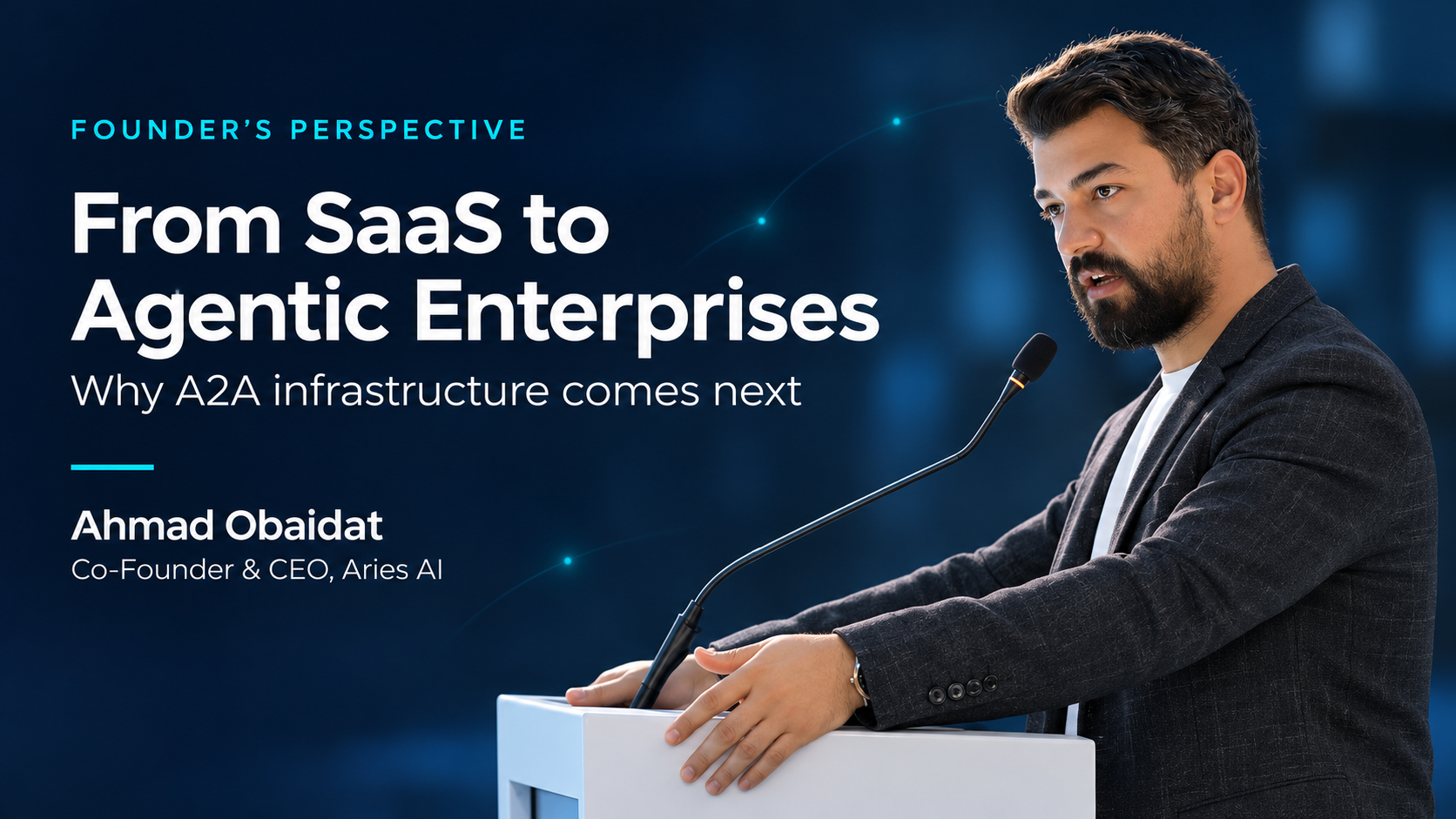
Founder’s perspective · Enterprise AI strategy
How collaboration between intelligent agents can change the way organizations execute work, measure results, and deploy human expertise.
By أحمد عبيدات· Co-Founder and CEO, Aries AI · 9 دقائق للقراءة
For years, enterprise digital transformation has focused on giving people better software. We introduced systems to manage customers, record transactions, coordinate teams, and analyze performance. These investments created the digital foundation on which organizations operate today.
But people still carry much of the work between those systems: extracting information, interpreting it, moving it into another application, following up, and assembling the evidence needed for a decision.
I believe the next evolution will address that coordination burden. Intelligent platforms will increasingly help execute defined business goals, with specialized agents managing parts of the work and collaborating across organizational boundaries.
This is the strategic significance of the move from SaaS toward Agentic as a Service. And as that ambition grows, the infrastructure for agent-to-agent collaboration becomes an enterprise priority.
SaaS remains the foundation. The operating model evolves.
SaaS describes how software is delivered. Agentic AI describes capabilities a system can use to interpret goals, select permitted actions, and adapt its execution. The two can coexist within the same platform.
Existing applications already contain valuable automation. They will continue to provide records, transactions, rules, and controls. Agentic platforms can build on those foundations by coordinating work that currently requires people to connect multiple steps.
The management question becomes more ambitious: which outcome can the organization delegate, under what conditions, and with what evidence of success?
Management must define what a successful outcome means
Delegating a goal requires more precision than requesting an output. “Prepare a report” is an instruction. “Produce a reconciled explanation of this month’s margin movement, with traceable calculations and unresolved questions highlighted” defines a more useful result.
Leaders need to specify the objective, constraints, quality threshold, deadline, and accountable owner. Teams then assess whether the result meets those conditions and supports the intended business decision.
The management task shifts toward defining good outcomes and making the quality of execution visible.
A task marked complete by an agent still needs to satisfy business acceptance criteria. Operational status and business success are separate measures.
Why agents need a common way to collaborate
An organization may use different agents for customer experience, finance, enterprise knowledge, and operations. Their usefulness can increase when they exchange relevant context and delegate work through agreed interfaces.
إن Agent2Agent Protocol, or A2A, is an open standard for communication between independent agent systems. It provides mechanisms for discovering capabilities, exchanging messages and outputs, and coordinating tasks without requiring agents to expose their internal implementation.[1]
A2A is distinct from the business orchestration and governance built around it. It enables a shared communication model; the enterprise must still decide which agents are trusted, what they may do, and how their results will be accepted.
It also complements the Model Context Protocol, or MCP. A2A addresses collaboration between agents, while MCP addresses connections to tools and resources. Traditional APIs and other integrations remain part of the architecture.[2]
An illustrative example: investigating a branch-performance problem
Imagine an executive asking why several branches are underperforming. A coordinated system could assign permitted data retrieval to one agent and financial analysis to another. A customer-experience agent could examine relevant feedback, while a knowledge agent checks operating policies and earlier corrective actions.
The resulting decision brief could connect the calculations, customer signals, proposed explanations, and unresolved uncertainties. Management could then choose a response, authorize the next steps, and monitor progress.
Each handoff would need agreed data definitions, access controls, and acceptance checks. Feedback suggesting slow service would remain a hypothesis to investigate rather than proof of the cause of declining revenue.
This is a target architecture illustrating the concept, rather than a claim that every product already supports this complete workflow.
Seven investments that make A2A useful in practice
My recommendation is to treat A2A readiness as a set of related infrastructure investments. Connecting agents is one part of making delegated work dependable.
1. A governed directory of agents
Organizations need to know which agents exist, what they can do, and who owns them. A2A Agent Cards describe capabilities and interaction requirements.[3] An enterprise directory should add approval status, supported versions, operating boundaries, and evaluation history. A declared capability still needs to be tested.
2. Identity and delegated authority
Every request needs a clear authority boundary. An agent retrieving information should not inherit permission to change it or pass broader access to another agent. Enterprise A2A guidance places authorization in the implementation and emphasizes granular permissions and least privilege.[4]
3. Shared business definitions
Agents need compatible meanings as well as compatible messages. “Revenue,” “resolved complaint,” and “active customer” must have agreed definitions. Exchanges should preserve the relevant entity, period, currency, source, and data freshness. Shared context should contain only the information the receiving agent is permitted to use.
4. Reliable task coordination
A2A supports trackable tasks, progress updates, requests for additional input, and terminal states such as completion or failure.[5] Around that lifecycle, organizations need dependency management, deadlines, controlled retries, and safeguards against duplicate actions. A failed handoff must remain visible to an accountable owner.
5. Secure access to operational systems
Agents need carefully scoped connections to the systems where work happens. Reading an invoice, preparing a payment recommendation, and executing payment should be separate capabilities. The architecture must preserve source permissions and enforce the approval required for each consequential action.
6. Evidence and evaluation
Important conclusions need traceable sources, and calculations should be checked against known rules and trusted data. Agents repeating the same mistaken source do not create independent verification. Tests should cover missing information, conflicting records, ambiguous instructions, and attempts to induce unauthorized behavior.
7. Operational visibility and cost control
Management needs a view of the complete task chain: delays, failures, human interventions, model usage, and cost. Set limits on spending, execution time, retries, and delegation depth. Operators must be able to pause work, revoke access, and recover from partial completion.
Human responsibility becomes more deliberate
As agents perform more extraction, analysis, preparation, and coordination, people can devote more attention to interpretation, relationships, prioritization, and decisions. But supervision itself requires expertise.
A reviewer needs to recognize an incorrect assumption, an incomplete data set, or a recommendation that overlooks commercial context. Human responsibilities also include defining policy, designing the workflow, resolving exceptions, and deciding when an agent should have less authority.
Review should be proportionate to the consequences. Routine, well-tested tasks may use automated checks and sampling. High-impact decisions need stronger evidence and explicit approval. The organization should retain enough domain expertise to challenge results and operate when an agent is unavailable.
What happens to the number of people needed?
Some workflows may require fewer human hours for a given volume of work. That can enable leaner teams in particular functions, reduce the need for additional hiring, or release capacity for growth and better service.
The effect on total headcount depends on actual reliability, demand, review effort, integration costs, and the organization’s priorities. Removing tasks from a role does not automatically remove the whole role.
The International Labour Organization’s research identifies job transformation as the most likely broad effect of generative AI because occupations contain tasks that still require human input. Its subsequent guidance also cautions that AI-exposure estimates are not forecasts of job losses.[6][7]
I would therefore start workforce planning with measured capacity: the manual effort removed, less the effort added for review, exceptions, governance, and maintenance. Then decide how to deploy that capacity. Training and redesigned roles should accompany the technology, so employees can move into work that requires stronger judgment and business understanding.
Measure the organization’s results, not just agent activity
A useful scorecard should connect execution quality with business value. I recommend establishing a baseline and tracking the following measures across the complete workflow.
| Measure | What to examine |
|---|---|
| Accepted outcomes | Work that meets predefined business acceptance criteria, including difficult cases. |
| Quality and rework | Errors, corrections, unsupported conclusions, and first-pass acceptance. |
| End-to-end cycle time | Total time, including queues, handoffs, approvals, and recovery. |
| Cost per accepted outcome | Model and infrastructure costs, review time, support, and maintenance. |
| Human capacity | Net hours released and whether they improve service, growth, or workload. |
| الأثر على الأعمال | The relevant result: service recovery, financial accuracy, operational continuity, or another agreed objective. |
Teams should also examine whether the system is becoming better at difficult work. A high success rate on easy cases can conceal failures in the situations where expertise matters most.
The leadership decision is to build for coordination
The next phase of enterprise AI will require deliberate investment in how agents collaborate and how people supervise them. My advice is to begin with one cross-functional workflow, assign an owner, and prove that the full chain produces an accepted result.
Expand responsibility as the evidence supports it. Keep reliable deterministic workflows where they serve the task well, and introduce agentic flexibility where interpretation and adaptation add value.
At Aries AI, the strategic direction I advocate is intelligence connected to context, governance, and action. A2A infrastructure is an important part of preparing for that future, alongside the business rules and human expertise that make it useful.
The enterprise of the future will be judged by the results its people and agents can reliably achieve together.
About the author
Ahmad Obaidat is Co-Founder and CEO of Aries AI, leading its vision, enterprise AI strategy, product direction, and international growth.[8]
المراجع
- A2A Protocol — official specification.
- A2A Protocol — A2A and MCP.
- A2A Protocol — core concepts and Agent Cards.
- A2A Protocol — enterprise implementation.
- A2A Protocol — life of a task.
- ILO — Generative AI and Jobs: A Refined Global Index of Occupational Exposure, 2025.
- ILO — what AI exposure indicators reveal about jobs, 2026.
- Aries AI — company and leadership.
Sources checked on 15 November 2026. Infrastructure recommendations and the illustrative workflow express the author’s strategic perspective.
تتحقق قيمة الذكاء المؤسسي عندما ينتقل من فهم السياق إلى اتخاذ إجراءات منضبطة.افهم ← قرّر ← نفّذ