
A sales director sees that revenue increased, but margin declined. The dashboard confirms the movement. The next question is more demanding:
“Which customer segments contributed most to the margin change, and how does that compare with the previous quarter?”
If the definitions, relationships, and measures are ready, the team can investigate. If they are missing, the question may become another request for the BI team.
That moment reveals a central challenge in business intelligence: the distance between having data and being ready to answer a new question.
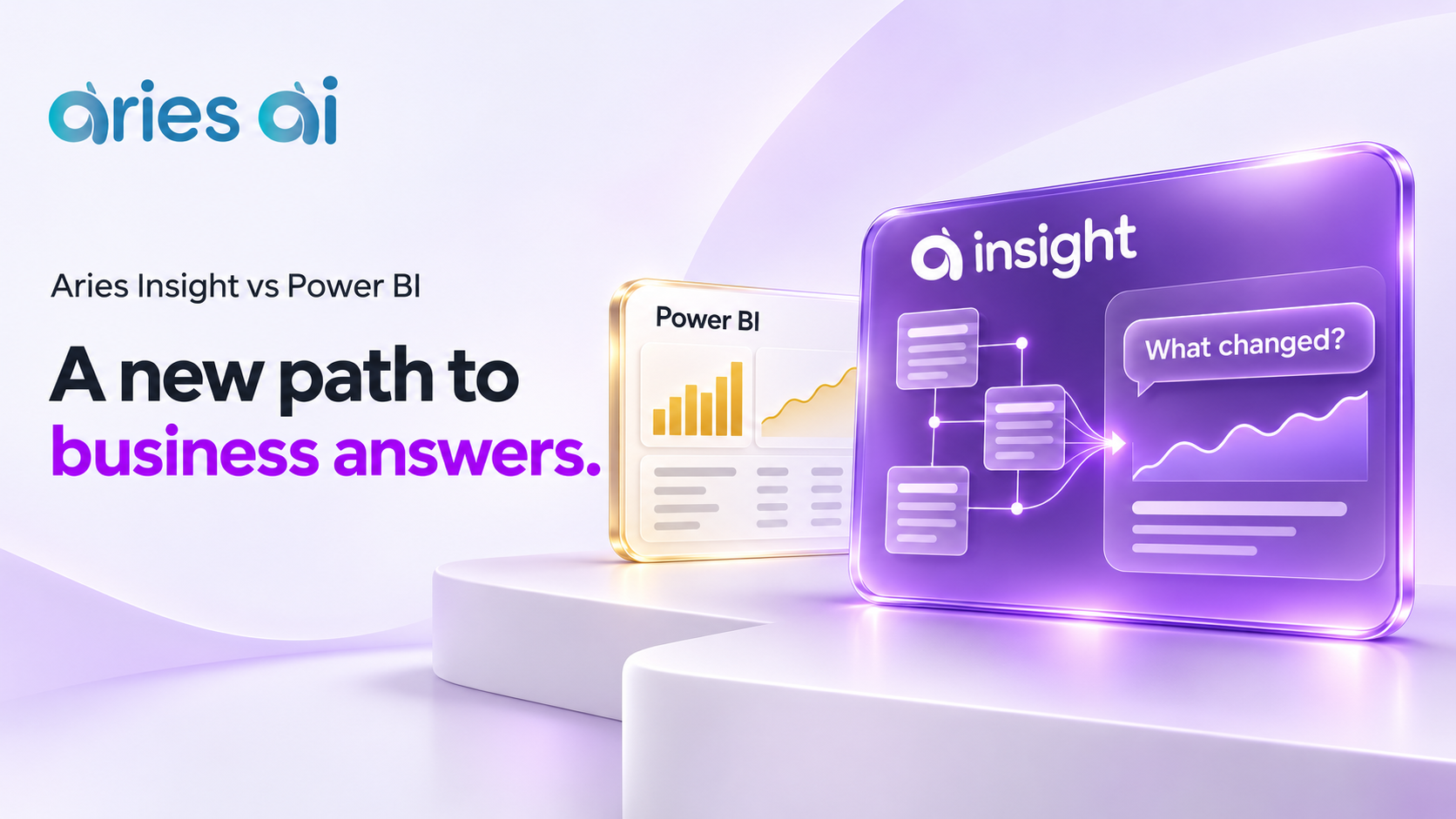
Power BI provides a mature environment for reporting and analytics. Aries Insight offers a different approach to preparing analytical understanding—automating more source discovery and interpretation, then making that knowledge available through conversation and dashboards.
The important comparison is who builds the understanding behind the answer—and how much of that work must be repeated.
Power BI is more than a dashboard tool
Power BI connects data, supports transformations and semantic modelling, and provides interactive reports, sharing, and governance. It is also a core part of Microsoft Fabric.[1]
Copilot adds AI-assisted exploration, report summaries, report creation, and DAX assistance within supported experiences. A comparison that treats Power BI as static charts would miss what the platform already offers.[2]
Aries Insight’s opportunity is more specific: reduce repeated preparation work and give business users a direct route into questions that still require additional analytical understanding.
Aries Insight vs Power BI at a glance
| Dimension | Power BI | Aries Insight |
|---|---|---|
| Analytical foundation | Tools to prepare data, define semantic models, and create reports. | Automated source discovery, profiling, and semantic knowledge-building as part of the product workflow. |
| Preparation work | Data teams and model owners define relationships, measures, and business context; AI can assist. | The platform undertakes more discovery and interpretation, with business clarification where evidence is incomplete. |
| Conversational analysis | Copilot supports questions and analysis within supported Power BI experiences. | A conversational analyst uses source knowledge and query results to support business exploration. |
| Questions beyond existing coverage | May require extending the semantic model or preparing additional content. | Designed to explore published source knowledge and calculate new answers where the available data and relationships support them. |
| Reviewing an answer | Models, measures, and AI preparation tools support review; diagnostic capabilities vary by experience. | Provenance can expose field bindings, measures, filters, and SQL behind an answer. |
| Visual analytics | An extensive reporting and visualization ecosystem. | Charts, dashboards, filters, publishing, versions, comments, and sharing alongside conversation. |
| Arabic experience | Assess language support for the specific interface and Copilot experience being deployed. | English and Arabic analyst experiences, including right-to-left presentation. |
| Strong evaluation scenario | Established reporting, curated models, and Microsoft analytics workflows. | Recurring ad hoc requests, underexplored source areas, and business-led conversational analysis. |
Qualitative product comparison, not a performance benchmark. Microsoft features vary by capacity, configuration, and release. Scope: Power BI and its Copilot experiences, rather than every Microsoft Fabric workload.
Explore the path from source to answer
The chart below compares the work involved in answering an established question and a new analytical question. Select a stage to inspect each approach.
The difference starts before the first question
A field named “sales” does not tell the whole story. Does it represent gross sales or recognized revenue? Which date matters? What does each row describe? Can the value be added across periods?
In Power BI, the semantic model supplies this analytical meaning. Microsoft recommends preparing that model for Copilot, using business context such as AI data schemas, instructions, and verified answers.[3]
Aries Insight places more of this preparation inside its own workflow. It discovers structures, profiles fields, measures candidate relationships, and organizes knowledge into business areas and reading guides.
The aim is reusable understanding. More questions can be explored using that foundation, while uncertain definitions remain matters for evidence and business confirmation.
Follow the question as it develops
A finance manager may begin with margin by business unit, then ask for a customer-segment breakdown and a comparison with another period. The analysis develops as the manager learns.
Insight is designed to support that progression through conversation, calculations, and visual answers, within the connected data, evidenced relationships, and access permissions available.
A measured difference can identify where to investigate. Establishing the cause of that difference requires additional evidence. Keeping those distinctions visible makes the analysis more useful.
Make the answer reviewable
Trust depends on being able to inspect how an answer was constructed. Aries Insight uses bounded, read-only queries and provides provenance that can show field bindings, calculations, filters, and SQL.
A reviewer can examine which period was selected, how “customer” was interpreted, and which conditions shaped the result. This supports discussion about the basis of an answer instead of relying only on fluent narration.
Power BI also offers modelling and review tools, including Copilot preparation and diagnostic capabilities. The evaluation should test how easily the intended users can inspect the answers they actually need.
Make analytics accessible in the language of the business
For Arabic-speaking teams, language affects participation. Aries Insight supports English and Arabic conversation, with right-to-left presentation for Arabic answers and interfaces.
This gives executives and operational teams a way to investigate performance in their working language. Test it with the organization’s real terminology, abbreviations, and business questions.
Keep the dashboards. Expand the questions.
A mature Power BI reporting estate can remain valuable. Established dashboards may already answer recurring questions efficiently.
Aries Insight can be evaluated alongside those workflows for additional source areas and questions that repeatedly create backlog. Its charts, dashboard spaces, filters, publishing, versions, comments, and exports give analysis a route into shared business work.
Direct source querying alone is not the distinction: Power BI also supports DirectQuery for supported sources.[4] The case for Insight rests on the preparation model and the connected analytical experience.
Evaluate the workload, not a promised percentage
Choose a set of representative questions: one your reporting already answers, one that regularly needs an analyst, and one from a business area that remains underexplored.
Compare preparation effort, the ability to ask follow-ups, access enforcement, and how easily users can review the result. Record the actual time and work required in your environment.
That is where the value becomes measurable: fewer repetitive preparation tasks, more useful exploration, and a clearer path from a business question to a defensible answer.
Bring the question your dashboard cannot answer yet.
Explore how Aries Insight builds source understanding, supports English and Arabic analysis, and turns questions into reviewable business insights.
Explore Aries AI / Request an Insight demo
Sources and scope
- Microsoft Learn: What is Power BI?
- Microsoft Learn: Copilot for Power BI overview
- Microsoft Learn: Prepare your data for AI
- Microsoft Learn: DirectQuery in Power BI
Aries Insight capabilities follow the supplied October 2026 product sourcebook, using features identified as shipped. Competitor documentation checked on 4 November 2026. No numerical performance comparison is asserted.
Enterprise intelligence becomes valuable when it can move from context to governed action.UNDERSTAND → DECIDE → ACT