
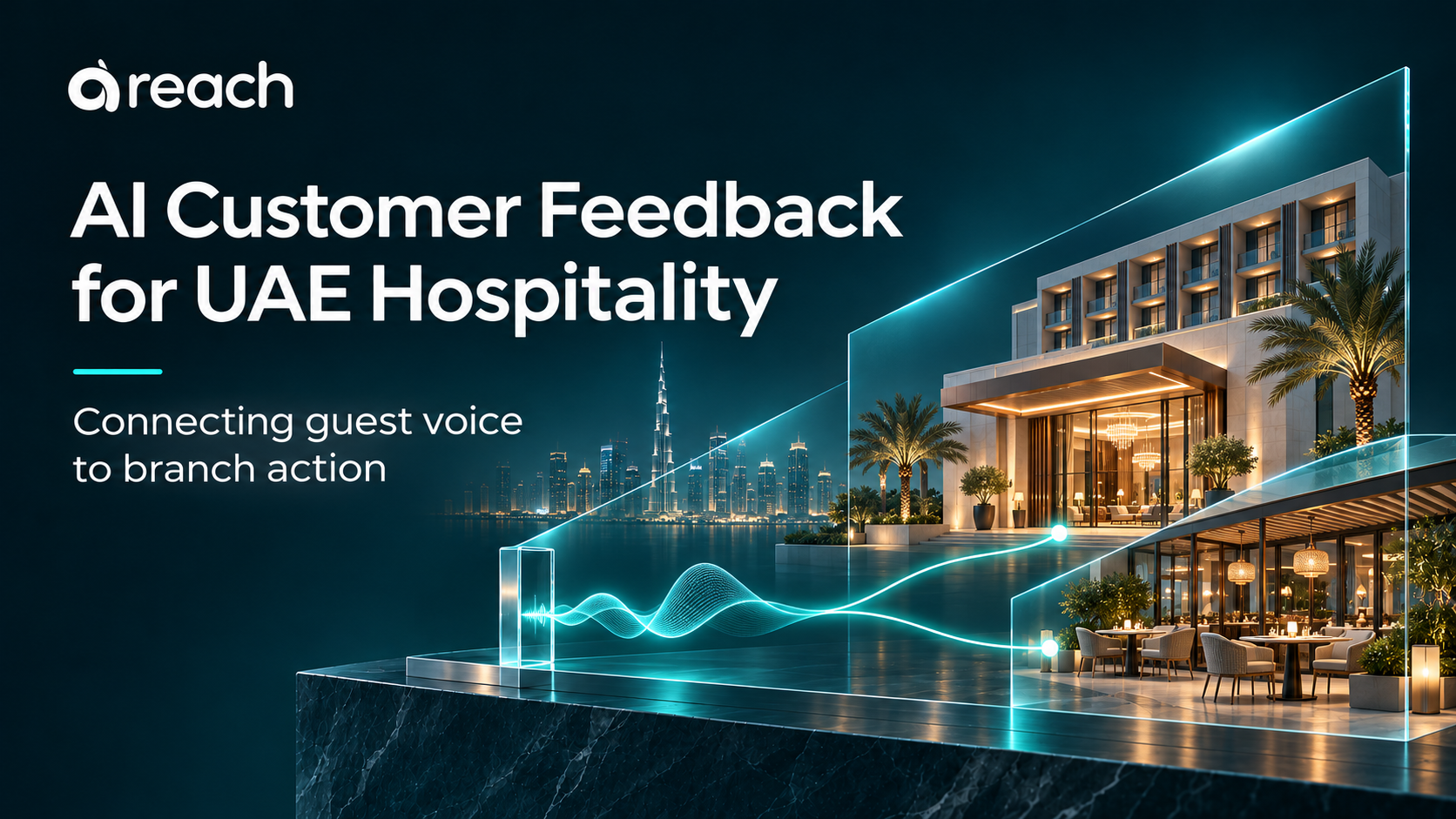
Aries Reach · UAE hospitality
Give guest feedback a clear destination: the right property, the right service team, and an accountable path to resolution.
Aries AI Editorial · 12 min read · Sources reviewed 8 November 2026
Multilingual guest voiceLocal ownershipGroup visibility
AI customer feedback becomes useful to hospitality operators when it connects what a guest says with where the experience happened, who should respond, and what evidence shows the issue was handled. For UAE hotels, restaurants, and multi-location service groups, that means combining multilingual listening with local accountability and a consistent management view.
A guest praises the food but mentions a long wait for the bill. Another describes an unresolved room issue after speaking to reception. A third reports a problem with a payment. An overall rating may capture dissatisfaction, but it does not tell the duty manager what to do next.
The UAE Tourism Strategy 2031 emphasizes tourism competitiveness, stronger capabilities, and a diversified visitor offering.[1] For an operator, dependable service across locations is a practical part of delivering that experience.
This is where Aries Reach offers a focused proposition: connect the guest’s voice to a governed response, then use the evidence to improve the next service interaction.
Editorial perspective: published by Aries AI. Product descriptions reflect published Reach information. The hospitality workflows, evaluation recommendations, and numerical example are illustrative; they are not named customer implementations or guaranteed results.
Feedback collection is the beginning of the work
A successful feedback journey should help the guest express the experience and help the operator understand what requires attention. A single submission can contain praise, a suggestion, a request, and a complaint.
For a hotel, the response may depend on the property, department, and whether the guest is still staying. For a restaurant, it may depend on the outlet, service period, and whether an immediate intervention is possible. For a leisure venue or other service operator, it may depend on the location and stage of the visit.
The operating model needs to preserve that context through every handoff. A translated summary that loses the outlet or an issue forwarded without an owner creates another queue rather than a better guest experience.
The essential shift: move from “we received feedback” to “the appropriate team reviewed the issue, took responsibility, and recorded the outcome.”
Where Aries Reach fits
Aries Reach is positioned as an experience and voice intelligence agent. Its published product information describes voice and text capture, transcription and translation, interpretation of sentiment, intent, topics and urgency, and governed routing and resolution of valid claims.[2]
The dedicated Reach site describes QR and link journeys, connected-channel intake, preservation of language and location context, and a workflow that distinguishes a signal from a claim before assigning responsibility.[3]
The hospitality value proposition is continuity: the original guest feedback remains connected to interpretation, local ownership, and follow-through. Leaders can evaluate the response process alongside the experience signals.
For a proposed implementation, confirm which intake channels, branch mappings, language functions, integrations, permissions, and notifications are included. Published ecosystem names do not establish every connector, version, or hospitality-system workflow as ready without configuration.
Design listening around the guest journey
Start with the moments where an operator can understand and use the feedback. A request raised during a stay may need immediate attention; a post-visit suggestion may belong in a planned improvement review.
| Operator | Useful listening moment | Context to preserve | Possible responsible team |
|---|---|---|---|
| Hotel or resort | Arrival, an in-stay service interaction, or departure. | Property, department, timing, issue, and a permitted stay reference where needed. | Duty management, front office, housekeeping, engineering, or guest relations. |
| Restaurant or café group | After a service interaction, payment, collection, or delivery. | Outlet, service period, order context where available, and the topic requiring attention. | Outlet management, service team, kitchen, or payment support. |
| Leisure or visitor venue | Entry, an activity, a queue, or a facility interaction. | Venue, zone, visit stage, timing, and relevant service context. | Guest services, venue operations, or the designated specialist team. |
| Multi-location service group | A consistent point across a comparable service journey. | Branch identity, brand, service type, language, and local responsibility. | Branch owner with regional or group escalation where appropriate. |
Use QR codes and links to make the listening moment accessible, with voice and text choices where supported by the agreed configuration. Avoid requiring a long questionnaire before a guest can explain a straightforward issue.
Map each collection point to a known location, and provide a way to correct an incorrect mapping. Ask only for additional information needed to understand or follow up on the issue.
A QR code can identify the intended collection location. It does not, by itself, prove that a submission came from a verified guest or completed visit. If visit verification matters, define the booking, transaction, or other appropriate evidence and confirm the required integration and privacy arrangements.
Preserve meaning across languages and mixed feedback
Hospitality listening should accommodate the languages guests actually use. Arabic and English may be important, but an international guest mix may require additional languages, accents, and mixed-language input.
Evaluate the full path: capture quality, transcription, translation, interpretation, and the output available to staff. A language list alone does not establish the quality of a particular task.
Consider this fictional message: “The meal was excellent, but we waited a long time for the bill, and I think I was charged twice.” It contains positive feedback, a service-delay complaint, and a payment concern. Reducing it to one negative sentiment label would lose the information needed for an appropriate response.
A useful review preserves those separate topics, the guest’s original wording, and any uncertainty. The payment concern needs checking against relevant evidence; the wait-time issue needs context. Neither statement alone proves the underlying cause.
Test real operating conditions: background music, quiet speech, local place names, brand terms, and short or incomplete messages. Give reviewers access to the relevant source so they can correct a transcription or interpretation before relying on it.
Give each material issue an accountable response path
Reach’s published workflow describes detection, validation, prioritization, assignment, resolution, and closure.[2] The following is a recommended way to apply that structure to hospitality operations; the exact rules and automation require agreement in the implementation.
| Stage | Operational question | Evidence or responsibility |
|---|---|---|
| Detect | Does the feedback include an issue needing attention? | Preserve separate topics and source context; distinguish praise, suggestions, requests, and potential claims. |
| Validate | What can the team establish from available information? | Check relevant context and records; retain uncertainty rather than treating an allegation as proven. |
| Prioritize | How quickly does the operator need to respond? | Use agreed impact and urgency rules, with prompt staff escalation for reports requiring immediate attention. |
| Assign | Who owns the next step at this location? | Name the responsible team or person, a backup, and the applicable response target. |
| Resolve | What did the authorized team do? | Record investigation, action, guest communication, and any required approval. |
| Close | What supports closure, and is follow-up still needed? | Keep outcome evidence, distinguish guest confirmation from internal completion, and allow reassessment. |
Urgent safety or security reports should reach designated staff promptly under the operator’s established procedures, even while details are being checked. Validation should not become a reason to leave an urgent report unattended.
Set response targets by issue type and operating context. An active in-stay request may need a different target from a post-visit suggestion. The target should have a clear start point, coverage hours, escalation route, and treatment of waiting time.
AI can help surface and organize the issue. Refunds, compensation, personnel decisions, and consequential actions should remain within the organization’s defined authority and approval process.
Make local ownership work across shifts and systems
A case assigned to the wrong property or an unavailable manager can look managed while making no progress. Define routing around the operating structure, including department responsibility, shift handover, absence, and escalation.
Keep one accountable owner for the outcome even when several teams contribute. A hotel engineering task may involve reception and guest relations; a restaurant payment concern may involve the outlet and finance. Record the handoff so the guest is not asked to repeat the issue unnecessarily.
Identify the authoritative case record. If the operator uses an existing service or customer system, establish whether the agreed integration creates a record, updates it, receives status changes, or only sends a notification.
For property-management, point-of-sale, booking, delivery, or other hospitality systems, confirm the exact product, supported interface, data permissions, and synchronization behavior. Do not assume a generic API or ERP reference means every required hospitality integration is included.
Test practical failures: a duplicate submission, an incorrect branch, an unavailable connector, and a case reopened after internal closure. The workflow should make the unresolved state visible to the people responsible for it.
Compare locations with context, not complaint counts alone
A busy location can receive more feedback simply because it serves more guests. A location with fewer submissions may have weaker collection coverage rather than better service.
The fictional example below uses a comparable service issue, equivalent periods, and consistently recorded visit counts. It illustrates a reported-signal measure, not the true prevalence of service failures.
| Location | Recorded visits | Wait-related feedback records | Records per 1,000 visits |
|---|---|---|---|
| Location A | 12,000 | 48 | 4 |
| Location B | 2,000 | 18 | 9 |
Location A has more wait-related records, but Location B has a higher number relative to recorded visits. That difference is a reason to investigate, not sufficient evidence to rank service quality or assign blame.
Check collection methods, participation, duplicates, visit definitions, service mix, issue coding, and small sample sizes. One submission may cover several topics, and one issue may be reported more than once. Define the counting unit before comparing locations.
Where a reliable denominator is unavailable, show counts and coverage limitations clearly. For hotels, select the denominator appropriate to the journey, such as stays or a defined service interaction, rather than mixing unlike measures.
A useful group view asks: where are comparable issues recurring, what is still unresolved, and what evidence would justify a change?
Give managers a service-recovery view and leaders an improvement view
The local team needs an actionable queue: issue, location, original context, priority, owner, due point, last update, and the next step. Group leadership needs trends that explain whether the operating process is improving.
Useful measures include time to an accountable owner, time to first meaningful response, unresolved-case age, reopenings, supported closure, and recurring topics. Distinguish an automated acknowledgment from a response that advances resolution.
Show median and slower-tail response times where useful, together with the number of cases measured. Separate open cases from completed ones so overdue work does not disappear from a metric built only on closed cases.
A live interface should show the freshness of each underlying source. Recently received feedback does not mean a connected booking or service record has refreshed at the same time. Confirm the proposed integration’s latency before calling the entire workflow real time.
For recurring issues, compare the evidence before and after an intervention. Record the owner, period, relevant operational changes, and guest-response pattern. A reduction in submitted complaints alone does not prove a reduction in the underlying problem.
Protect guest trust while connecting operational context
Collect the information needed for the service purpose. Guests should understand how their feedback and any contact details will be used, and whether they can submit feedback without identifying themselves.
Separate guest-facing communication from internal investigation notes, and limit access to recordings, booking references, employee information, and sensitive allegations to appropriate staff. Anonymous feedback can still inform improvement, though individual verification and follow-up may be limited.
The UAE government describes the federal Personal Data Protection Law and its provisions concerning processing, individual rights, and cross-border transfers.[4] Have the responsible teams establish the obligations applicable to the operator and proposed processing, including relevant sector or jurisdictional requirements.
Reach publishes an enterprise data-processing template covering roles, instructions, deployment responsibilities, and other review areas. It states that the template becomes binding when incorporated into an executed agreement.[5] Confirm the actual processing locations, model and speech services, retention, support access, and contractual terms for the project.
Private feedback and public reviews serve different purposes. Use service recovery to address the issue without making a remedy conditional on changing a public review. If inviting Google reviews, its policy prohibits incentives, discouraging negative reviews, and selectively soliciting positive ones.[6]
Pilot one guest journey before expanding across the group
Select a bounded journey at a manageable set of locations, with real managers and shift teams involved. Agree in advance on what will establish useful improvement.
- Map the service context. Define locations, departments, collection points, issue categories, owners, and escalation routes.
- Evaluate multilingual interpretation. Include mixed sentiment, unclear descriptions, relevant accents, and messages containing several issues.
- Test accountability. Follow cases through assignment, handover, connector failure, investigation, communication, and closure.
- Measure the full process. Include review effort, corrections, guest follow-up, operating costs, and time to an accepted outcome.
- Review with local and group owners. Decide what to expand, revise, or stop using the evidence and remaining limitations.
A practical pilot includes a genuine suggestion that should not become a complaint case, a duplicate report, an urgent report needing prompt human attention, and a resolved issue that the guest says is still open.
Use the results to refine the operating rules and training. Expansion should reproduce a working service process, with consistent definitions and local ownership, rather than simply distributing more QR codes.
Make every useful guest signal easier to act on
For UAE hospitality operators, the value of AI feedback lies in a better connection between listening and service. The guest needs a usable way to speak; the branch needs context and responsibility; leadership needs evidence of resolution and recurring issues.
Aries Reach brings a published focus on voice intelligence, multilingual interpretation, and governed follow-through to that evaluation. The next step is to apply it to the operator’s actual journeys, systems, and service responsibilities.
Capture the experience. Preserve the context. Assign the response. Learn from the outcome.
Explore Aries Reach for your hospitality operation
Bring a guest journey, your location structure, required languages, and an existing service-recovery process. Use them to assess the right Reach configuration and a measurable pilot.
Explore Aries Reach · Discuss your UAE hospitality requirements
Frequently asked questions
What can AI add to hospitality feedback?
It can help organize voice and text, identify separate topics and urgency, and support routing and analysis. Its usefulness depends on interpretation quality, operational context, ownership, and the response process.
Does a branch QR code verify that someone visited?
No. It can associate a submission with an intended collection point. Visit verification requires a defined evidence mechanism, such as an appropriate booking or transaction match, with the required configuration and safeguards.
Can Reach support hotels and restaurant groups?
Reach’s published experience-intelligence model can be evaluated against both workflows. Confirm the property or outlet structure, relevant channels, service rules, hospitality integrations, and implementation scope for the operator.
Will every negative comment become an incident?
The published Reach approach distinguishes feedback signals from valid claims. Agree on how requests, suggestions, potential claims, duplicates, and urgent reports are reviewed and handled in the configured workflow.
Can guests provide feedback in different languages?
Reach is positioned as multilingual. Test the languages, accents, capture methods, interpretation, and staff-facing outputs required by the guest mix in the selected configuration.
How should a hospitality group measure success?
Use a baseline and agreed measures of interpretation quality, assignment, meaningful response, unresolved work, supported closure, repeat issues, and operating effort. Evaluate guest outcomes alongside collection coverage and reporting limitations.
Sources and further reading
Sources reviewed 8 November 2026. Official sources support UAE context and the cited policies. Aries sources describe published product positioning and contractual review material. Workflow recommendations and the numerical branch comparison are original editorial illustrations.
- UAE Government: UAE Tourism Strategy 2031
- Aries Reach: experience intelligence, interpretation, and governed claims
- Aries Reach product site: intake journeys, context, multilingual intelligence, and response workflow
- UAE Government: data protection laws
- Aries Reach: enterprise data-processing template and deployment responsibilities
- Google Maps: prohibited and restricted content, including review manipulation
Enterprise intelligence becomes valuable when it can move from context to governed action.UNDERSTAND → DECIDE → ACT