
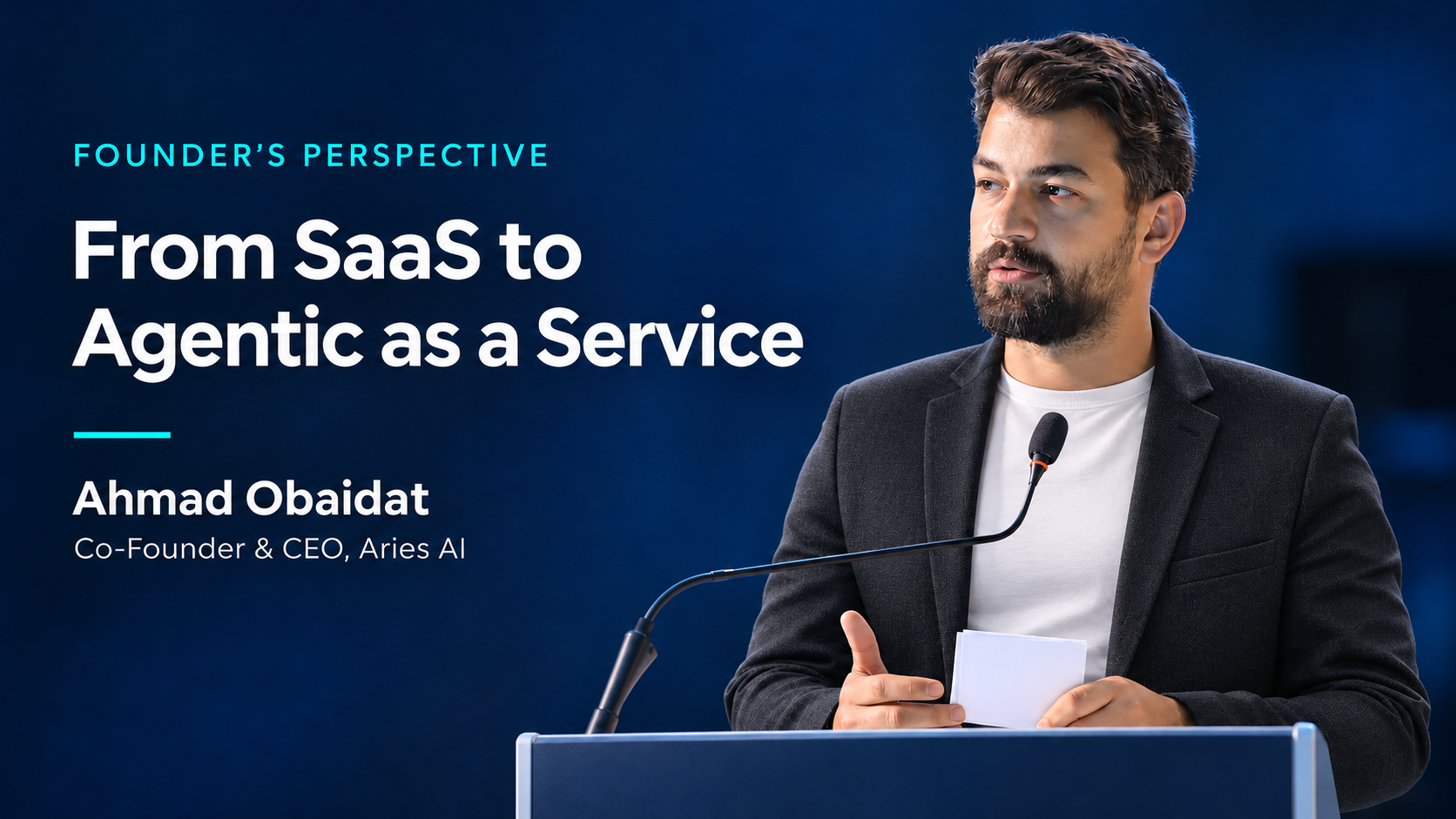
Founder’s perspective · The future of enterprise AI
Why the next chapter of enterprise technology will be measured by the work it helps complete—and the trust behind every action.
By أحمد عبيدات· Co-Founder and CEO, Aries AI · 7 دقائق للقراءة
Software as a Service changed how businesses access technology. It made powerful applications easier to deploy, update, and use across teams. It also gave organizations a foundation for connecting data and digitizing work.
I believe the next evolution changes what businesses should expect from that software.
A dashboard can show a problem. An assistant can explain it. An agentic service can help investigate the context, determine an appropriate next step, use approved tools, and carry the work forward within defined boundaries.
That progression is what I mean by Agentic as a Service: giving organizations access to intelligent capabilities that can pursue defined goals, with evidence, permissions, and human accountability built into the process.
The next chapter builds on SaaS
SaaS is a delivery model. Agentic capability describes how a system operates. They can exist together: a cloud application can deliver agentic services, while enterprise agents can also operate in private-cloud, on-premise, or hybrid environments.
Modern SaaS already includes automation, analytics, and sophisticated workflows. The additional opportunity is for AI to interpret a goal and adapt the steps it takes as new information arrives, rather than relying entirely on a fixed sequence.
The distinction matters. A predefined workflow can be the right choice for a predictable task. More flexible agent behavior becomes useful when the path requires interpretation and adjustment. The design should follow the problem, not a desire to maximize autonomy.[1]
From access to software, toward delegated execution
Consider a customer complaint. Recording it is useful. Summarizing it saves effort. Moving it toward resolution requires more: understanding the issue, checking relevant evidence, identifying responsibility, and tracking what happens next.
An agentic service should help connect those steps. Its authority must remain explicit. Preparing a response, assigning a case, issuing a refund, and closing a complaint are different actions with different approval requirements.
The goal is to give people less coordination work while preserving their authority over consequential decisions.
| الأولوية | A software-access question | An agentic-service question |
|---|---|---|
| القدرة | Which features can my team use? | Which defined task can the service help complete? |
| Coordination | How do users move work through the application? | Which steps can the agent coordinate, and when must a person intervene? |
| التحكم | Who can access the system? | What can the agent read, recommend, and execute on someone’s behalf? |
| Value | Are people using the product? | Is accepted work completed more effectively, at a sustainable cost? |
How we approach this evolution at Aries AI
At Aries AI, our direction is to connect enterprise context with governed action. Our published approach emphasizes specialized intelligence, traceable evidence, and respect for human authority.[2] Each product addresses a different part of that ambition; the scope of execution depends on its workflow, integrations, and configured controls.
Aries Insight: from business questions to decision-ready evidence
Aries رؤية gives users a conversational way to explore governed enterprise data and produce analysis and visual evidence.[3] The opportunity is to reduce the work between asking a question and reaching an informed decision. For example, a question about declining margin should lead to reviewable calculations and relevant context. A recommendation still needs an accountable decision-maker.
Aries Reach: from customer signals to accountable response
Aries Reach connects multilingual feedback analysis with validation, prioritization, ownership, and resolution tracking.[4] Its contribution to this shift is the connection between understanding an experience and advancing a response. A negative comment is a signal to examine; a validated issue can enter a governed action path.
Aries Notes: from meeting records to approved commitments
Aries Notes connects meeting content with source-linked decisions, reviewable minutes, owned actions, and policy-based follow-up.[5] The important boundary is approval. AI can help identify a proposed commitment, but authorized people confirm what was agreed, who owns it, and when it is due.
Aries Ops: from incident queues to controlled response
Aries Ops enhances existing IT service management with incident intelligence, SLA-risk insight, and controlled automation.[6] Here, an agentic approach can help interpret context and coordinate approved response steps. Execution must remain connected to runbook permissions, approval rules, and evidence of what changed.
Aries Bot: trusted knowledge as a foundation for work
Aries Bot provides multilingual answers from governed enterprise content, with attention to permissions and source evidence.[7] Reliable knowledge is essential to agentic work: a system needs permitted, relevant context before it can propose a useful next step. Answering a question and executing a transaction remain distinct capabilities.
Greater capability requires clearer boundaries
As AI takes on more steps, organizations need greater visibility into its behavior. They should be able to see the goal, the information used, the actions attempted, and the approvals required.
I see five essentials: a defined mission, least-privilege access, traceable evidence, explicit approval boundaries, and a clear route for exceptions. If information is missing or contradictory, the service should surface that uncertainty. If an action fails, the failure should remain visible and recoverable.
The most valuable agent is one you can trust with the authority you have deliberately given it.
Multilingual capability belongs within that same discipline. Understanding words in another language is only part of the task. The system also needs to preserve meaning, business terminology, and the distinction between a suggestion and an authorized commitment.
Measure completed work, including the effort behind it
Agentic as a Service should change how we evaluate value. Login counts and generated responses tell us about activity. Business value requires a closer look at whether the work was useful, accepted, and completed.
A meaningful evaluation might measure the time to an accepted analysis, the progress of validated complaints, the completeness of approved meeting actions, or the resolution of eligible IT incidents. It should also include human review, corrections, exceptions, integration effort, and model consumption.
A fast answer that creates substantial rework may deliver less value than a slower, reliable process. Cost per accepted task is often a more useful measure than cost per generated response.
This is an operating principle, not a requirement for one pricing model. Subscription, usage-based, and other commercial arrangements can all support agentic services. The important question is whether the organization can demonstrate value from the work performed.
Start with a mission the business can evaluate
My recommendation is to begin with one bounded use case. Define the starting condition, the permitted actions, the human owner, and the evidence required to call the task complete.
Establish a baseline, test representative situations, and include difficult cases. Expand the agent’s responsibility as evidence supports it. This creates a stronger foundation than introducing broad autonomy before the organization understands how to supervise it.
The future is software that helps move work forward
SaaS made software widely accessible. Agentic as a Service raises our expectations of what that software can help accomplish.
For me, the opportunity is to give people more capacity to exercise judgment, serve customers, and lead their organizations while intelligent systems handle more of the coordination around them.
That is the direction we are pursuing at Aries AI: specialized intelligence that understands context, works within control, and contributes to measurable progress.
The next chapter of enterprise software will earn its place through work completed, evidence preserved, and trust maintained.
About the author
Ahmad Obaidat is Co-Founder and CEO of Aries AI. He leads the company’s vision, enterprise AI strategy, product direction, and international growth.[2]
المراجع
- Anthropic — Building effective agents. Referenced for the distinction between predefined workflows and dynamically directed agents.
- Aries AI — company approach and leadership.
- Aries رؤية — enterprise decision intelligence.
- Aries Reach — experience intelligence.
- Aries Notes — meeting intelligence.
- Aries Ops — intelligent IT service management.
- Aries Bot — enterprise knowledge.
تتحقق قيمة الذكاء المؤسسي عندما ينتقل من فهم السياق إلى اتخاذ إجراءات منضبطة.افهم ← قرّر ← نفّذ