
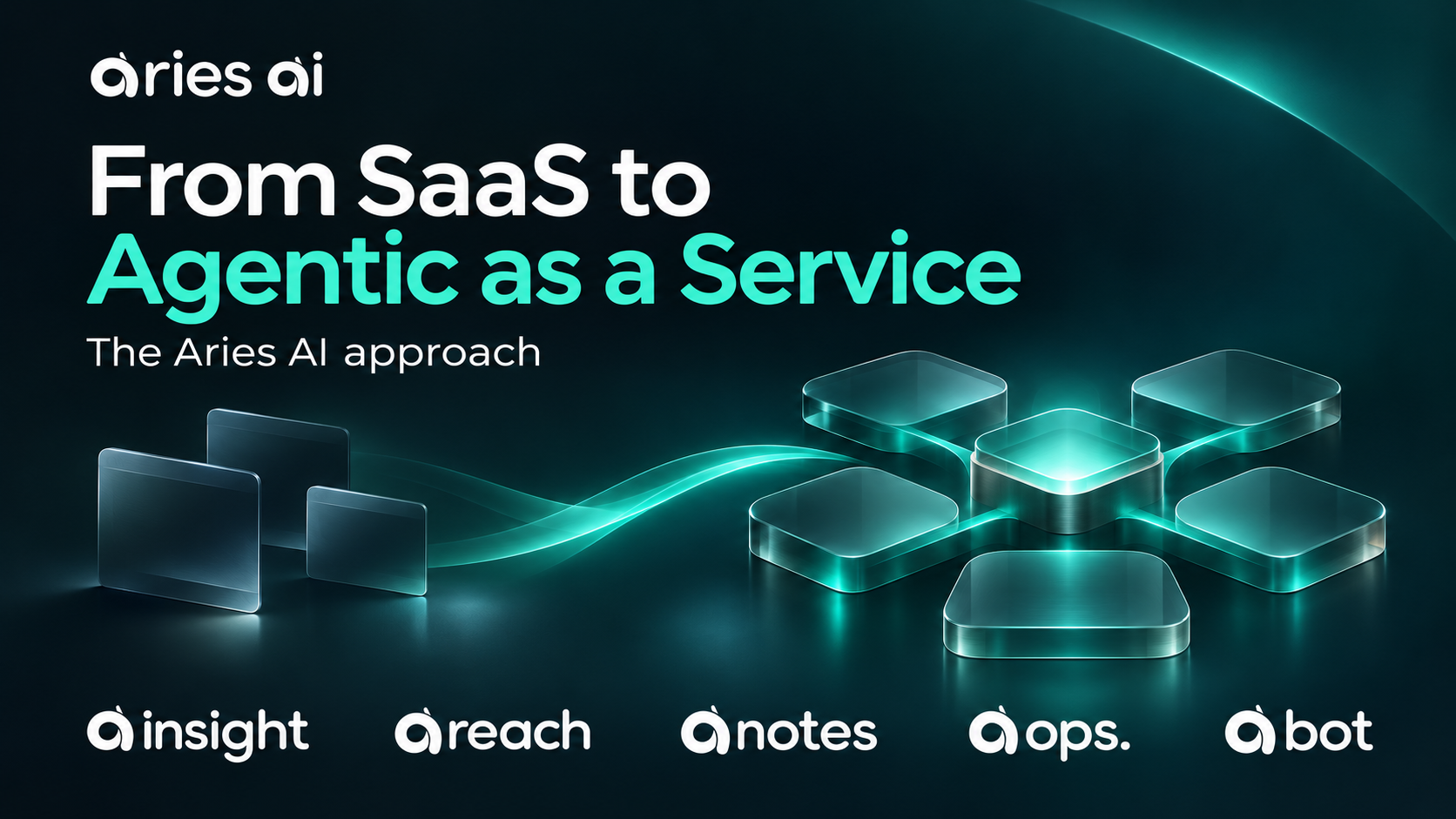
企业 AI · The next operating model
Enterprise software is evolving from a place where people manage work into an intelligence layer that helps move the work forward—with context, permission, and accountability.
Aries AI 编辑团队 · 12 min read · Product sources reviewed 8 November 2026
A dashboard can reveal a problem. A ticket can record it. Meeting minutes can describe the decision to fix it. The harder question is whether the right action follows—and whether anyone can show what happened.
This is the opportunity behind Aries AI’s direction: bring specialized intelligence into the flow of enterprise work so that information can become a decision, an assigned responsibility, or an approved operational response.
Aries AI’s published platform content presents five agents—Insight, Reach, Notes, Ops, and Bot—within a governed ecosystem connecting data, experience, meetings, operations, and organizational knowledge.[1]
That direction can be understood as a move from Software as a Service toward Agentic as a Service: a shift in emphasis from access to application features toward AI-supported work delivered within a defined business mission.
The core idea: the enterprise sets the objective, context, and authority. The agent performs the analytical or operational steps it is permitted to perform, while people retain responsibility for decisions and outcomes.
What does Agentic as a Service mean?
In this article, Agentic as a Service (AaaS) describes an operating model in which specialized AI capabilities are delivered around ongoing business work: understanding a request, using relevant evidence, preparing or carrying out permitted steps, and preserving a record of the result.
The term is used here as a description of Aries AI’s product direction, rather than a claim that Aries AI invented the category. It also does not announce a new pricing contract or guarantee a business outcome.
The distinction is practical. A user might ask for an explanation of declining margin, submit a service complaint, approve a meeting commitment, or report an IT incident. The useful question becomes: how much of the path from that signal to a defensible result can the service perform?
Many SaaS applications already automate work and include AI. Agentic service is therefore an additional capability and operating layer, not a clean replacement for everything SaaS provides. Existing applications can remain the systems of record while agents help interpret context and coordinate permitted work.
The shift: from operating features to progressing a mission
Consider the following as a comparison of operating emphasis, rather than a claim that every SaaS product behaves alike.
| 维度 | Software access emphasis | Agentic service emphasis |
|---|---|---|
| Starting point | A user opens an application to complete a task. | A business question, event, request, or commitment starts a defined service workflow. |
| 上下文 | People often assemble information across tools. | The agent works from connected, permitted business context. |
| Work performed | Users operate features and coordinate the next steps. | The service can interpret, analyze, prepare, route, or execute approved steps within its scope. |
| Human role | People operate the process and make its decisions. | People define objectives, confirm meaning, grant authority, review exceptions, and retain accountability. |
| 证据 | Records may be spread across screens and systems. | Answers and actions should remain linked to sources, permissions, decisions, and execution history. |
| Value assessment | Access and feature adoption are useful measures. | Time to a validated answer, accountable resolution, and verified follow-through become central measures. |
| 部署 | SaaS usually describes remotely delivered software. | Agentic describes how work is performed; the deployment may be cloud, private cloud, on-premise, or hybrid. |
A conversational interface alone does not establish this shift. The substance lies in the work behind it: what the agent can understand, which systems it can use, what it can do, and where approval is required.
Five agents, five business missions
Aries AI’s comparison center organizes the products by their input, mission, and output. That provides a clearer foundation for an agentic service than treating every agent as a general-purpose chatbot.[9]
| Agent | 起点 | Published workflow emphasis | Business deliverable |
|---|---|---|---|
| Aries Insight | Business questions and enterprise 数据 | Plans and performs governed analysis; produces visual evidence and explanations. | A reviewable analytical answer and decision support. |
| Aries Reach | Stakeholder voice, text, feedback, and claims | Interprets experience signals and connects valid claims to ownership and follow-through. | An issue with context, priority, an owner, and a resolution path. |
| Aries Notes | Meetings, decisions, and commitments | Prepares source-linked records and supports approved ownership, reminders, and escalation. | An approved record and accountable commitments. |
| Aries Ops | Incidents and service events | Classifies, summarizes, correlates, and supports governed resolution within existing ITSM. | A controlled service response with an execution trail. |
| Aries Bot | Questions and organizational knowledge | Retrieves permitted evidence and prepares grounded, source-aware answers. | Relevant knowledge delivered within access boundaries. |
Capabilities and integrations depend on the selected product, deployment, and configuration. The deliverables describe the products’ published roles, not guaranteed results from every implementation.[2][4][5][7][8]
Aries Insight: from navigating reports to conducting analysis
Business questions rarely arrive in the same format as a reporting model. Someone asks what changed, which group contributed most, or where attention is needed next. Translating that question into valid analysis is part of the work.
Insight’s published content describes natural-language exploration over governed data, analytical queries, visual outputs, and inspectable evidence. Its dedicated product site also describes source understanding built from schemas, labels, values, and candidate relationships, with owner control over relationship interpretation.[2][3]
This moves the service beyond displaying a prepared report: it can help translate intent into an analytical path and return an answer for review.
The agentic contribution: performing more of the work between the business question and a reviewable analytical answer.
Insight’s boundary matters. Its published workflow emphasizes controlled, read-only access where supported and visible analytical lineage. A recommendation is decision support; it should not be interpreted as permission to modify an ERP or execute a commercial decision automatically.[3]
Aries Reach: from collecting feedback to organizing a response
A feedback repository records what people said. An operational experience service must also help distinguish an ordinary comment from an issue that needs attention.
Reach describes a path from stakeholder voice or text through transcription, interpretation, claim validation, prioritization, ownership, and resolution tracking. The service retains the experience context while connecting valid claims with an accountable response.[4]
For a multi-location organization, this makes branch context and responsibility part of the experience workflow. A complaint can be reviewed alongside its source, routed to the relevant team, and followed through a defined case process.
The agentic contribution: turning experience signals into prioritized work with a responsible owner and a visible follow-through path.
This does not mean every negative comment should become an incident or that an inferred cause is automatically correct. Claim validation and the configured response policy determine what proceeds.
Aries Notes: from documenting meetings to governing commitments
The value of a meeting is not exhausted by its transcript. Decisions need context, commitments need owners, and follow-up needs a clear basis.
Notes’ product pages describe source-linked meeting records, decisions and actions, review and approval, policy-driven reminders, escalation, and outcome verification. Speaker attribution and timestamps connect extracted conclusions to their original moment.[5][6]
The published governance model keeps human authority explicit: AI prepares the record, while review and approval establish what can be distributed or acted upon.
The agentic contribution: supporting the lifecycle of a commitment, from the conversation that created it to the evidence needed to close it.
That distinction protects the organization from treating an AI interpretation as a binding instruction. A suggested task and an approved commitment are different states.
Aries Ops: from managing a ticket queue to controlled service response
In IT operations, context is often scattered across an incident record, related tickets, service dependencies, and known resolutions. Reassembling that context repeatedly consumes specialist time.
Ops is positioned as an intelligence layer over existing ITSM environments. Its published scope includes incident classification, summarization, correlation, SLA intelligence, knowledge generation, and controlled resolution automation. The original ITSM remains the system of record.[7]
This is the most direct execution-oriented example in the five-product story: the service can help interpret an incident and support a governed operational response instead of only explaining the queue.
The agentic contribution: progressing service work through contextual triage and permitted automation, with a traceable connection to the original service record.
The scope of self-healing must be defined by approved runbooks, integration permissions, and execution policy. A high-impact change requires the authority appropriate to its risk; the agent’s ability to suggest a response does not itself grant that authority.
Aries Bot: from searching repositories to receiving grounded guidance
Finding a document is only part of answering an enterprise question. The response must use the relevant version, respect access boundaries, and show where its claims came from.
Bot’s published workflow describes permission-aware retrieval, privacy controls, grounded response generation, and source citations across connected organizational knowledge. Its mission is to bring permitted context to the user’s question.[8]
The agentic contribution: carrying out the retrieval and answer-preparation work needed to turn fragmented knowledge into relevant, reviewable guidance.
Bot’s contribution is different from operational execution. A source-linked policy answer can help someone act correctly, but it does not establish that Bot independently changes business records or approves a transaction.
The larger opportunity is in the handoffs
The five products become especially interesting when a business mission crosses domains. Aries AI’s platform and comparison content describe a governed ecosystem in which agents can be combined when the operating need justifies it.[1][9]
Consider an organization investigating recurring service failures across several branches. The following is an illustrative architecture built from the published product roles; it is not a claim that every deployment includes these connections out of the box.
- Reach surfaces the experience issue. The team reviews related complaints, customer wording, urgency, and branch context.
- 洞察 examines the business evidence. With the necessary approved sources connected, the team compares relevant service and performance measures.
- Ops supports the technical response. If an IT incident is confirmed, permitted integrations and operational policy define the service response.
- Notes preserves the decision and commitments. The review meeting produces a source-linked record, confirmed ownership, and approved follow-up.
- Bot makes approved guidance accessible. Where the resulting guidance is published to an authorized knowledge source, staff can retrieve relevant instructions with citations.
The value is continuity: preserving context, responsibility, and evidence as the work moves between domains. The implementation still needs explicit data mapping, permissions, approval rules, and supported integrations.
Governance is part of the service
Autonomy is useful only within a clear operating boundary. The appropriate level varies by task: retrieval, analysis, drafting, routing, and system-changing execution carry different responsibilities.
Across its platform and product content, Aries AI emphasizes identity, permissions, approvals, auditability, deployment choice, and multilingual context.[1][2][4][5][7][8]
A deployment should make five questions easy to answer:
- What can this agent access? Define permitted sources, fields, documents, and user context.
- What can it do? Separate read, recommend, draft, route, and execute permissions.
- Who approves consequential steps? Specify the accountable person and the approval conditions.
- What happens when evidence is insufficient? Establish how the workflow pauses or reaches a qualified reviewer.
- How is the outcome checked? Retain the source, decision, execution record, and relevant closure evidence.
Aries AI also publishes cloud, private-cloud, on-premise, and hybrid deployment options. The architecture and service agreement should identify the actual boundary for data, models, integrations, and support access. Agentic capability describes how work is performed; it need not require a single hosting model.
Measure completed work, not the number of AI conversations
The commercial conversation should connect the service to a defined operating result. A feature list and a high message count cannot establish that a workflow improved.
Useful measures depend on the mission:
- Insight: time to a validated answer, correctness of analysis, and specialist effort required.
- Reach: time to an accountable owner, resolution evidence, and repeat complaints.
- Notes: review effort, confirmed owner coverage, and commitments closed with evidence.
- Ops: triage quality, resolution time, successful permitted automation, and exceptions.
- Bot: answer correctness, citation support, access-policy compliance, and time to useful guidance.
These are proposed evaluation measures, not results claimed for a particular customer. Establish a baseline, preserve the measurement period, and include review, administration, integration, and service costs.
That is how the value proposition moves from “we added AI” toward “this business mission is being performed more effectively.”
Start with one mission. Expand with evidence.
An enterprise does not need to activate every agent at once. Aries AI’s own comparison framework recommends starting with the signal, defining the mission, preserving the evidence, and connecting agents where the work crosses boundaries.[9]
Choose a problem that has an owner and a measurable result. Give the agent the context and authority needed for that task. Evaluate its output and exceptions. Expand only when the evidence supports a wider role.
Seen this way, Aries AI’s move toward Agentic as a Service is about a more substantive relationship between software and work. 洞察 helps develop the answer. Reach organizes the response. Notes carries the commitment. Ops supports controlled resolution. Bot brings the permitted knowledge.
The shared direction is an enterprise in which intelligence participates in the workflow and remains accountable to the people, policies, and evidence that govern it.
Bring the workflow. Define the right intelligence.
探索 how Aries AI’s specialized agents can support the business mission your team needs to improve next.
探索 the Aries AI agents · 比较 their missions
Frequently asked questions
Does Agentic as a Service replace SaaS?
It can build on existing SaaS and enterprise systems. The distinction is the work the agent performs within a mission, rather than a requirement to replace the underlying application.
Are all Aries AI agents fully autonomous?
The published product roles describe different levels of assistance and action. Insight emphasizes governed analysis, Bot grounded answers, Notes human-approved commitments, Reach accountable response, and Ops controlled operational automation.
Does “as a service” mean payment only for outcomes?
Not in this article. The term describes the operating proposition. Pricing, service levels, scope, and responsibilities must be established in the relevant product agreement.
Sources and further reading
All references below are published Aries AI content, reviewed 8 November 2026. “Agentic as a Service” is this article’s interpretation of the documented product direction. Product descriptions establish published scope, not an independent performance audit; no illustrative website metrics are presented here as verified customer outcomes.
- Aries AI: enterprise intelligence and the agent ecosystem
- Aries Insight: enterprise decision intelligence
- Aries Insight: analytical workflow and source understanding
- Aries Reach: experience intelligence and governed claims
- Aries Notes: meeting intelligence and human-approved follow-through
- Aries Notes: commitment governance and outcome verification
- Aries Ops: intelligent IT service management
- Aries Bot: permission-aware enterprise knowledge
- Aries AI comparison center: missions and governed handoffs
当企业智能能够从上下文转向受治理行动时,便创造价值。理解 → 决策 → 行动